Chief Joseph Worked Hard to Avoid Conflicts with Early White Settlers
Contributed by Jim Reavis
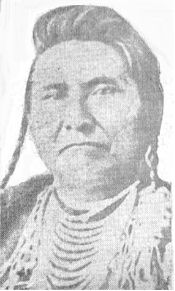 |
By Roy Carter In 1871, Old Joseph, father of the famous Nee Percé Chieftain, Chief Joseph, died and the son became chief. During the, next few years there was constant friction between the tribe and the government which still hoped to move the Non-Treaty tribes onto the reservation in Idaho. Settlers were beginning to move into the Wallows Valley and there was constant strife between them and the Indians. There can be no doubt that the white men were fully conscious of what they were doing in buying the Wallow Valley from Lawyer. A document signed by the secretary of the Treaty Council reads - "Finally it was concluded to make the treaty with the Lawyer band - Joseph's band never had anything to do with the treaty, never would have, and have never and never will receive any of the annuity good or any other benefit from the Government, claiming then, as they do now, that Lawyer and his chiefs were not the rightful chiefs of the Nez Peace and consequently had not the right to treat with the commissioners to cede their possessors right." Unrest continued. George Collier Robbing says in his "Pioneer Reminiscences", |
|||
|
"In Southern Idaho, Indian women and children were killed in attacks made by volunteer soldiers." A citizens committee posted rewards for Indian scalps; $100 far a buck's, $50 for a squaw's, and $25 for anything in the shape of an Indian under ten. Ulysses S. Grant, then president of the United States conceded the right of Joseph's people to the land but under pressure from groups both in Oregon and in the office of Indian Affairs reversed his position and declared the land open to homesteading. The government pressed for removal of the tribe from the valley to the Lapwai reservation. Joseph, still remembering his father's wish that the bones of his father and his mother would never be sold questioned the availability of land suitable for cultivation.
In the mind of the resident Indian agent there was
no question: "There is not enough to give heads of
families twenty acres apiece."
Still hoping that a war could be be averted, Joseph
at last agreed to leave the land of his fathers and move
onto the Lapwai reservation, holding that he had not
sold the land, that though he might never live there
again, the land still belonged to his people. And again
General Howard pointed out that they would have one
month make the move and that unless they were upon the
reservation at the end of that month, he would send
troops for them. An undercurrent of bitterness ran like wildfire through the camp. All the old wrongs were aired and repeated in variation throughout the night. Revenge was asked for and only Joseph remained immobile in his insistence an keeping peace at all cost. A council was held, unattended by Joseph whose wife was expecting a child and they lived apart from the encampment. Even Joseph's brother, Alicut, counseled war, as strongly as Joseph counseled peace. On the night of June 13, four warriors of the tribe led by White Bird could endure the rising tide of emotion no longer. They left camp and before morning the war that had been smoldering for so long flamed into violence. They rode into camp the following, day with horses and rifles they had taken from the bodies of the settlers they had killed.
Joseph, who had been gone during this time,
returned to learn of the bloodshed. He had counseled
peace but peace was no longer possible.
He led there across the Lobo pass into the
Bitterroot Valley of Montana through the Big Hole and
was forced to double back down through the Yellowstone
to avoid contact with troops moving up from the south,
led by Colonel Miles. When the battle brake out, Joseph sent riders to Sitting Bull for aid and he fought a bitter delaying battle, hoping for reinforcements from the leader of the Sioux Nation and the hero of the Little Big Horn. The battle lasted for five days and it was then that it became evident no aid would come to help them. Joseph, realizing the futility of further resistance, surrendered to General Howard on the moaning of October 4 with these wards: "Tell General Howard I know his heart. What he told me before I have in my heart. I am tired of fighting. Our chiefs are killed. Looking Glass is dead. Tu-hul-hil-sote is dead. The old men are all dead. It is the young men who say yes or no. He who led on the young men is dead. It is cold and we have no blankets little children are freezing to death. My people, some off them, have run away to the hills, and have no blankets, no food; no one knows where they are perhaps freezing to death. I want to have time to look for my children see how many of them I can find. Maybe I shall find them among the dead, Hear me, my chiefs, I am tired; my heart is sick and sad. From where the sun now stands I will fight no more."
White Bird with what remained of his band escaped
during the night across the border, he, whose people had
been responsible for the war, found freedom in Canada.
General Sherman, at the close of the campaign when
the facts were before him had to write: "'Thus has
terminated one of the mast extraordinary Indian Wars of
which there is any records. The Indians throughout had
displayed a courage and skill that elicited universal
praise; they abstained from scalping; let captive women
go free; did not commit indiscriminate murders of
peaceful families (which was usual) and fought with
almost scientific skill, using advance and rear guards,
skirmish lines and field fortifications." According to the terms of surrender, the Nez Percé were to be returned to Lapwai as soon as was humanly possible to do so, which meant the following spring. A violent uproar protesting this by the whites living near the reservation prevented action and the tribes were put on Indian Territory in Oklahoma. Joseph fought for the return of his people to their homeland, to Lapwai. In this fight he was aided by Colonel Miles who had promised them as much at the surrender, and who felt the government duty-bound to do so. Joseph spoke with Senator Graver, who had led the pressure group which had resulted in President Grant's reversal of position on the ownership of the Wallow Valley and who now headed the commission appointed to investigate Joseph’s claims to him, he said: “I do not like this
country (the Indian Country). I have seen enough of it
since I have been kept in it. I have lost eighty of my
people and I am afraid of this country. We must all die
if we stay here. When I stopped fighting I surrendered
to Howard and Miles. I wished for peace. At that
surrender we came to an understanding with these two
generals. It was a true understanding. We supposed we
were to be sent to our own country, but we were brought
down here.
In 1897, Joseph left the
reservation for Washington, D. C. Again white men were
encroaching upon his land. While in Washington he was
invited to participate in the dedication of Grant's tomb
in New York City, which he attended before he returned
gratefully to his home. His wit and his wisdom are best expressed in the words of the man himself:
His last funeral rites were
performed in 1905. A granite monument, built with funds
donated by James J. Hill, railroad magnate, was
dedicated at that time and his personal possessions were
distributed among his relatives and the members of his
tribe.
|
||||