An Incident in the Career of the Celebrated Chief Joseph
Contributed by Jim Reavis
| Chieftain, July 16, 1897 WALLOWA HISTORY By Mr. E. S. McComas. Mr. E. S. McComas, of Baker City in a letter to the New York Sun, which has been devoting considerable space to Chief Joseph, says of the famous Nez Percé: To my venerable enemy and friend, Chief Joseph, I want to do an act of justice that has been too long delayed, relating facts probably never before put in print, which can be verified by many residents of Baker, Union and Wallowa counties. Or, I am no sentimental admirer of the blanket Indians of a generation ago. I have seen too many of their horrible atrocities and have suffered too much myself for that. For 34 years my hand has been constantly sore from the hurt of a poisoned arrow. I once had to tramp 100 miles with an Indian bullet imbedded in the bones of my leg before I could have medical attention. Sentiment has nothing to do with my |
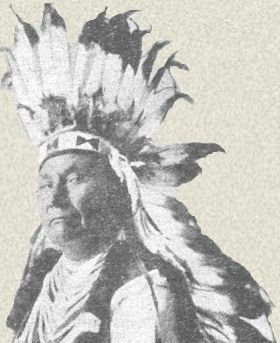 |
| present story. In the early summer of 1877, I lived in Union county, Or., and published the Mountain Sentinel. A courier from Wallowa valley, 80 miles away rode into town one morning with an appeal from the citizens over there for help in standing off Chief Joseph and his band, who were about to slaughter them. They had already sent to Fort Walla Walla for government assistance. Seven of us volunteered to go. The rest felt it their duty to protect their own homes at such a time. When we volunteers reached Wallowa we found a company of 30 ready and anxious to go out and offer battle to Joseph, who was encamped with 105 men about 20 miles away. I knew a bit more about Indian fighting than they and persuaded them to wait for the regulars, who arrived at daylight the next morning. The combined forces, 81 men in all, moved on Joseph at once. At noon we halted three-fourths of a mile from the Indians’ strongly fortified position. Squire Veasey, a very intelligent citizen, was awaiting our arrival with an invitation from Joseph to Lieutenant Force to come over across Hurricane creek, which had been established by mutual consent as the dead line between the settlers and Indians. Lieutenant Force and Mr. Veasey at once mounted and rode over to interview Joseph and, after probably two hours, returned with the information that an agreement had been reached that the Indians and their stock would be kept on the north side of Hurricane creek and the whites and their stock should remain on the south side unmolested until a report of the situation could be sent to “the Great Father in Washington.” This let the gore hunters from Grande Renell out, and there was gnashing of teeth, especially among the young and reckless ones, who had never tried their shot at a red blanket, and Lieutenant Force was denounced as a coward. Seeing that our mission was at an end, and not at that time knowing the arrangements that had been made, and having heard often of the beautiful Wallowa lake and the remarkable red fish that it contained I was anxious to visit the lake. So I called Captain Booth to one side and said: “Captain, let us take the commissary wagon and some blankets and grub and go up to the lake and catch some fish.” He at once consented and we proceeded. Several young men were anxious to go, none understanding that our going was a violation of the treaty. We selected five to ride in the wagon and Captain Booth and I mounted our horses and started for the ford in the direction of Joseph’s camp, the road to the lake crossing the creek just below Joseph’s camp and winding around the base of the hill on which he was fortified. When about half way to the ford a little corporal or lieutenant, who hailed from the evergreen isle, and was probably born near its greenest spot over took us at a gallop and thundered in our sensitive ears: “Lieutenant Force order yez back!: We enquired why, and he said: “None of yer damned business phy: yez fellows come back; that’s phy.” I at once told him to present Captain Booth’s compliments to Lieutenant Force, and tell him that we were going up to the lake, and that he had not men enough to stop us, and just to say to the lieutenant that he had our permission to go where over coats are not needed in the dead of winter. The little Irishman literally destroyed the grass on his way back, and delivered the message probably verbatim, for Lieutenant Force and Mr. Veasey immediately mounted and dashed over to Joseph’s camp as fast as their horses could carry them. Then there was a commotion. We could hear Joseph’s voice that your correspondent says “is now a murmur” speaking to him men in trumpet tones and from my knowledge of the Nez Percé language I knew that he was pleading to restrain them from sweeping down on us; but we went on. We cautioned our boys on the wagon to be ready for trouble, but to say not a word, and we drove on. Thus by Joseph’s control over his bare and hideously painted warriors our lives were saved. Joseph could not readily understand why Lieutenant Force had no control over us, and at first insisted that if the lieutenant could not stop us he thought his men could, but he placed unlimited confidence in the word of Mr. Veasey, who gave his pledge that we would do no wrong. This Mr. Veasey must have done with some misgivings, for he well knew the feeling that existed among the citizens toward what at that time seemed to them to be a disposition on the part of Lieutenant Force to avoid an encounter with Joseph and his warriors. We went on to the lake, camped that night, and returned during the afternoon of the next day. Again the Nez Percé were drawn up in line behind the wall of rock on the hill. We instructed the boys with the team to make no demonstrations and to say not a word, but to drive quietly along the road and on to camp. Captain Booth and myself rode just behind the wagon. When opposite the camp a fool hardy idea struck me and I said: “Captain lets us go up and see Joseph: I want to get a buckskin thong to fix my stirrup strap.” The captain said: “All right; go ahead.” We rode up the hill in the face of about 100 hideously painted and scowling warriors and went directly to Joseph’s tent. In front of his tent was a little Indian boy, probably 8 years old. Dismounting, I handed him a piece of silver and gave him the reins of my horse to hold, but he handed the reins to another boy and darted into the ten to show his father the money. As Joseph was sulking and had not shown himself, which was ominous, we deliberated a short time. I finally said to Captain Booth: “Let us hang our guns on our saddles, so as to appear unarmed and go into the tent.” We did so, I had a large ivory handled six-shooter stuck in the inside pocket of my coat, and as I stooped over to enter the door of the tent my gun fell at my feet. Your correspondent may tell about Joseph’s impassive face, but I saw it change then and his eyes fairly shot fire. He made a movement as if he were about to spring to his feet, and had he done so your readers would not be hearing from me now. I endeavored to appear unconcerned at the blunder, and picking up the revolver, stuck it in the side pocket of my coat. I saluted Joseph in Chinook, a language commonly understood by Indians of the section. To this he made no reply. I then proceeded to tell him that our hearts were good, and that I had been present and had met him when he had held a talk with Senator Slater, and that I was engaged in “making paper talk at Union,” and had called to get his statement to publish it and send it to the Great Father in Washington. While this was not strictly true, I felt that the play was within the limits of the game; and I made it stick. This interested Joseph at once, and he motioned us to be seated on a buffalo robe at his feet. I produced some tobacco and a pipe and we smoked. I took out my notebook and he called an interpreter. I wrote as if my life depended on it, and when I got home I published the interview, but not the incidents that led to it, which have never before been penned. At Joseph’s suggestion his wife cut me a string for my stirrup we bade him good day. Soon after this he crossed Snake river and went over to Camas Prairie. There, some of his warriors having secured whisky and got drunk among the settlers, blood was spilled. The subsequent campaign has gone into history. Chieftain, Jan.
22, 1903
Spokane, Washington, Jan. 18.—Chief Joseph, of the Nez Percé, is in the city on his way to Washington, D. C., where again he will use every effort to induce the Government to return a portion of the Wallowa Valley to his tribe. He remained in Spokane today, only waiting her until a suitable interpreter could be secured. R. B. Scoots of this city, who has already acted in this capacity, will go with Joseph. The chief accompanied by Red Thunder, and Olocot, two nephews. Red Thunder who is the only one of the three that can speak English, will not accompany them. Chief Joseph is along in the 60’s, and still his ambition is to see the tribe of which he has been the most noted warrior and leader, hold the choice lands that they have wanted for many years. |
|