Sparta, Baker County, Oregon
Sparta: Sparta is 20 miles NE of Baker city. Follow Highway 86 and watch for the Sparta turnoff, then north on a graveled road for about 5 miles of uphill grade to an old stone store building. This was built about 1872 by the Cohn-Heilner Brothers and is all that remains of this old gold producing town, which also served as a stage stop between Baker City and Eagle Valley.
Family and Friends in Sparta
Hardscrabble living made for tough families and close friends
|
|
|
|
|
Unrefined Sparta in 19th Century
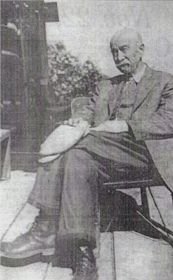
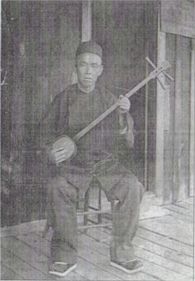
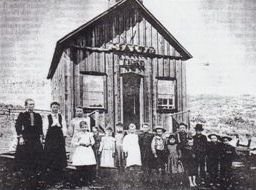
In late 1800's Sparta was an established outpost for miners. Post Office opened in 1872, closed 1952. Emigrant Sigmund Heilner constructed in 1872 a stone building to house dry goods and groceries. The structure remains presently in Sparta. Catharine Ott ,81, graciously shared photos for this article. Joe Wright operated the Sparta store, which was prime source of supplies for the mining community. Wright was a confirmed bachelor whose "true love" refused to come west when he migrated from Eastern states. His disappointment was so deep that he never married for the remainder of his life. See photo #1 Joe, the merchant, developed close friendship with Catharine Ott's grandparents, the James Shaver family. These ties were so steadfast that years later, when Joe Wright fell ill, he was cared for in his final days in the Shaver home. Catharine Ott at the time an impressionable 8 year old, remembers the scene of Mr. Wright's body lying in state in the front parlor of her Grandmother Shaver's residence. Pioneering families of the area were of necessity hardy souls. Their strength was tried when they endured bitter winters and cleared roof high snowdrifts. Daily chores consisted of breaking solidly frozen ice in watering troughs. Mud was a year round common denominator, but no deterrent to gold seekers who flocked to the area. Ott smiled when she related the women's view of primitive living under disagreeable circumstances. Her Mother among other women referred to their living quarters as "could ya shacks", connotation meaning "could you live HERE and still love him?" While gold searching was principle venture for men folk in Sparta, uppermost in the minds of the Mother's was school larnin' for children. In 1891 a batten board one room school was constructed. By 1898 teacher Victoria Worsham had 15 students under her tutelage. (See photo #3 ) She is shown at left. In the picture Catharine Ott provided, her Mother Virgie Shave is shown 5th from left. A small girl in striped dress. Several Macy children are shown, their relatives continue residing today in Baker City. Norma Macy Smith is of that heritage line. Apparently in a formal photo of 1898, young boys considered a hat a necessity, while bare feet were admissible. Chinese laborers were in the area to help construct the 22 mile long Sparta Ditch, which provided water for sluicing gold. One Chinese gentleman, Aw-Wing, became a special friend of the James Shaver family. The name Aw-Wing transposes into "Mr." Because Aw-Wing held James Shaver in high regard, the Chinaman had a photo taken (a rare occasion) and presented it with respect to friend Shaver. Aw-Wing chose to pose on the porch of his one room residence, where a weather beaten board with Chinese lettering identified his home. He also chose to hold his prized possession, a primitive musical instrument. ( See photo #2) When strumming 3 strings held by wooden pegs, the plaintive twang reminded Aw-Wing of his homeland. The slightly faded photo, mounted on cardboard , today remains with the Shaver family offspring. This closes an intriguing chapter of Sparta, OR. A community marked by close knit, caring residents of the nineteenth century, who triumphed over trauma. They survived only by aiding each other in times of trial. A small cemetery on adjacent knoll is mute testimony of the dream seekers who failed. Similar stories of truth abound from other Baker County ghost towns, but remain untold. Perhaps another boomtown would result if a few specks of hidden treasure surface, and rumors catch the attention of modern prospectors. Printed here with the permission of Baker City Herald |
||