Maxville a Logging Camp, Wallowa County, Oregon
| Maxville was a logging camp owned by Bowman-Hicks Lumber Company. At the time it was started J.D. McMillan was the superintendent and it was suggested that the first part of McMillan be used to name the Community, Maxville. In 1908 the railroad was extended from Elgin to Joseph. This opened up a vast area of Virgin Pine Timber. The Palmer Lumber Company who had operations in Union Co. began extending their operations to Wallowa County. They began by buying up homesteads for the timber on them. In 1913 Frank Victor didn't sell his homestead to Palmer but sold Palmer a 20 year lease on his timber on Smith Mountain. The timber was near to where Camp 5 was built. In 1910 the Palmer Lumber Co. hired Morrison-Knudsen to construct a rail line from a siding about two miles up the Wallowa River from its junction with the Grande Ronde River. This siding was named Vincent, named for Vincent Palmer. From here a track v as built up Howard | |
 |
Creek for a distance of five
miles to a logging camp called Camp Five. The last three
miles was a 6% grade. From here branch lines were extended
to other locations. Palmer Lumber Co. used steam powered donkey skidders, but horses were used to skid logs to where the donkey engines could reach them. The logs were loaded on a train and shipped to the mill. The company had six locomotives. One of these was a Shay which had which had a weight of 110 tons. The Shay was gear driven and was used on steep grades. The small locomotives, which were of 35 to 70 tons were used to bring the logs from spurs to the yards at Camp 5. This is where the shay took over. The shay would hook onto 20 loaded double- |
| deck of cars and start down the 6% grade to Vincent. The logs and cars were put on
a siding and the shay returned for another load. Camp 5 not
only had a machine shop but a roundhouse also. They had 4
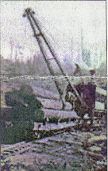
donkey engines skidding and loading logs. In 1919 the company went to Spokane and purchased a McGiffert loader. It was said to be the largest loader built. Only two were built. It stood on stilts and this huge machine straddled the track and the train passed under it when being loaded. It could also reach out 114 mile and skid logs to be loaded. To move to a new place the loader was let down on the track and moved under it's own power. It proved to be too difficult to move and repair and was not a success. |
|
| In 1922 Bowman Hicks a Lumber
Co. from Louisiana purchased the Palmer Lumber Co. operation
at Camp 5. This was the only temporary camp so Bowman-Hicks
began looking for a permanent camp. They sent Don Riggle who
was raised on Smith Mountain along with Joner Trump and John
Carper to find a new location. This location must be large
enough for a town of 4 to 5 hundred people, level enough for
train tracks, and water for the town and locomotives. Don
Riggle knew of such a place, the Bishop Meadows. The Bishop Meadows were large and flat with a stream that could be dammed up creating a pond for water. In 1923 the Co. began construction of Maxville. The rail-road workers lived in |
|
| cars and tents until cabins were built. A large log building was the first to be constructed. In September the post office was moved from Camp 5 to Maxville. By the end of the year the town, a school, a bunk house and mess hall for the 80 single workers. Housing was built for the married men and families. It also had a baseball field, a swimming hole, a doctor office and running water. | |
|
|
In 1924 Bowman-Hicks purchased the Nibley-Mimnaugh Mill in
Wallowa and ex-tended it's railroad line to Wallowa, a
distance of 16 miles. Eight steam locomotives began hauling
logs from the Maxville area to Wallowa. In 1922 Camp 5 was
only a temporary camp so many men left their families behind
until a permanent camp was established. One of these workers
was Herman Anderson. He left his wife Adelee and his 3
girls, Vivian, Leona, and lone in Louisiana. In 1923 when
Maxville was established he sent for them. They went by
train to Elgin where they were met by a company speeder.
They and all the luggage was loaded on the speeder and they
traveled 20 miles to Camp 5. It was an experience they never
forgot. Vivian who is 89 years old still has memory of the
ride. Adalee said that the most happy years of her life was
spent at Maxville. Her three daughters attended school
there. In 1925 her son Kenneth was born at Maxville. Herman was a log cutter and this usually required a partner. They usually got along OK if one didn't ride the saw. One day Herman got a new partner who had a tendency to ride the saw. |
| When he accused him of it he denied it.
Herman got mad and said he was quitting. They then decided
to divide the equipment. The only thing they didn't have 2
of was the saw. When his partner asked about it, Herman said
he would take care of it. He laid the saw on a large pine
stump, took his ax and cut it in two. 20 years later
Herman's 1/2 of the saw was still on the stump which was
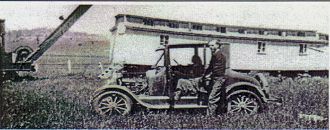
near the Victor Meadows. Herman and his family then moved to Wallowa. Here a daughter, Vera Jeane was born. After moving to Wallowa his work took him away from home. He was only home on weekends. He and his partner, Shorty Barnett worked in the woods as far as Kinzua, Oregon. In the 1940s they were cutting on U.S. Forest Service Land. The snow was deep and the ground steep. They cut timber all winter and it was after the snow melted that an inspector came by to measure the height of the stumps. Instead of measuring the high and low sides and take an average measurement he only took from the low side of the ground and said the stumps were too high and all stumps had to be cut off. They were told if they didn't cut the stumps they would never cut another log on Forest Land. They went back and cut 1 to 2 inches off every stump. Herman said he would never cut another log and quit. He then got a night watching job at the Little Duck Saw Mill in Wallowa. He retired in 1949 and lived out his life in Wallowa. In 1948 I married his daughter Vera Jeane and we have enjoyed more than 55 years of married life, which includes our daughter Linda who was born December 7th, 1949. In 1922 when Bowman-Hicks took over the Camp 5 operation
they let a contract to furnish meat, milk, and cream for the
cookhouse, which furnished meals to the single workers. The
contract was given to my dad, Alva Victor. He built a
slaughter house and butchered own beef and hogs. He
purchased a new Model T truck in Elgin and then hired his
brother-in-law Harold Carroll to help him. At first he
delivered to Camp 5 then to Maxville in 1923. Morrison-Knudson had the contract with both Palmer Lumber
and Bowman-Hicks to build their train tracks. Morrison and
his mother lived at Maxville. His mother was always bragging
on her son. She said that he was only 42 and was already a
millionaire. One day she asked if my dad would do her a
favor, he said he would. She said that she was low on
bathroom tissue and would he stop at Shells and get her a
supply. On his next trip instead of going to Shells he
stopped and picked a bunch of mullen leaves, put them in a
box, and told her that Shells were out of tissue but would
have a new supply in time for his next trip. Her response
was "Thank you Mr. Victor, thank you Mr. Victor." On his
next trip he had a supply of tissue for her. After leaving
Maxville Morrison-Knudson became one of the largest
construction companies in the United States. |
|
|
|
|
When the 1929 Depression hit, the lumber
market declined, and people began leaving Maxville. One of
the first businesses to close shop was the dining room of
the Maxville Hotel. Vivian and Ione Anderson were working at the dining room when it closed. The hotel had no |
| money to pay them, so they were
paid with dishes. Part of Vivian's pay was a large bowl,
seen here. This bowl has been in her family for seventy-five years and is still used by her granddaughter, Susan James of Portland, Oregon. Our thanks to Wallowa History Center for providing this bit of Wallowa County History |
|

Wallowa County